

 AGENTOPS & MANAGED AIAgentOps & Managed AI
Shipping Is Not the Finish Line. It Is Where the Operational Work Begins
Models drift. Input distributions shift. Prompt behavior changes when the underlying model updates. Costs compound quietly. AgentOps catches all of it, before the business does.
The Problem
What Happens Six Months After the AI Ships
An InsurTech VP of Engineering shipped an AI claims triage system eight months ago. Launch went well. Business metrics improved in Q1.
Then, gradually, they didn't.
 Escalation rates crept from 31% back to 47% over four monthsNobody noticed until a senior adjuster mentioned it informallyThe underlying model provider updated their base model in month five, prompt behavior changed silentlyRetrieval accuracy degraded as new document types entered the knowledge baseLLM API costs grew 34% on volume that grew only 18%, cost-per-query rising, nobody watching
None of these were catastrophic failures. None of them surfaced as an incident.

They accumulated over four months while the system appeared to be running normally.

This is what AI system degradation looks like in production. It is rarely a crash. It is a slow drift, output quality declining by fractions, costs compounding, until the effect becomes visible in business metrics that trail the technical reality by months.
The Problem
Why Standard Monitoring Is Not Enough
Infrastructure monitoring, uptime, latency, and error rates tell you whether the system is running. It does not tell you whether the system is working.
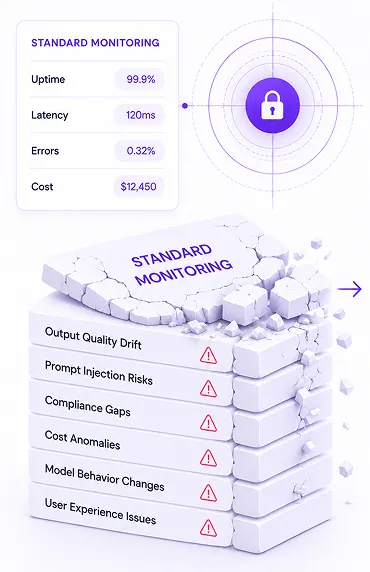
Three properties of AI systems require monitoring that standard DevOps tooling was not built for:

Output quality is not directly observable
A traditional software system either returns the correct value or it does not. An AI system returns an output that may be more or less accurate, and the only way to know which is to evaluate it against a reference standard on a scheduled basis. Standard monitoring cannot do this. An eval pipeline can.

The system changes without a deployment
When an LLM provider updates their base model, the behavior of every prompt running against it changes. When a new document type enters a RAG corpus, retrieval accuracy changes. None of these triggers a deployment event. All of them change how the system performs.

Cost is a compound variable
LLM API costs are a function of token volume, model selection, prompt length, and retrieval architecture. All four shifts in production. Without structured cost monitoring, organizations routinely discover that production AI infrastructure costs 2–3× the original estimate, months after the divergence begin.
What AgentOps Covers, 6 Operational Domains

Output Quality Monitoring
Scheduled evaluation of production outputs against the ground-truth eval suite built during the original engagement. Accuracy, precision, recall, hallucination rate, confidence calibration, measured at defined intervals. Alerts are triggered when metrics fall below agreed thresholds before degradation reaches operational impact.

Prompt Versioning & Change Management
Every prompt change is version-controlled, tested against the eval suite before deployment, and rolled back automatically if post-deployment metrics degrade. Model provider updates are assessed for prompt behavioral impact before they propagate to production.

Retrieval Accuracy Measurement
For RAG systems, retrieval precision, recall, and citation accuracy are measured on a scheduled basis against the adversarial evaluation suite. Corpus update pipelines are monitored for document types and volume changes affecting chunking strategy performance.

Cost Monitoring & Optimization
Token usage, cost-per-query, total monthly spend tracked per system and per workflow. Optimization recommendations are issued when cost-per-query diverges from the deployment baseline by more than the agreed threshold.

Compliance Posture Monitoring
Audit trail integrity checks, access control drift detection, prompt injection surface monitoring on a scheduled basis. Regulatory change tracking for HIPAA, SOX, and the EU AI Act, with architecture impact assessment when requirements change.

Escalation Pipeline Maintenance
Human-in-the-loop escalation paths are tested monthly to confirm that routing logic, notification delivery, and handoff documentation remain functional as the upstream system evolves. Escalation rate is tracked as a leading indicator of output quality degradation.
Engagement Model
Structure: Monthly retainer with defined service scope agreed at the start.

Observability infrastructure
LangSmith for LLM application tracing + a client-accessible dashboard covering the metrics engineering and product teams care about day-to-day.

Alerts
Route to the client's engineering channel, Slack, Teams, or PagerDuty.

Significant findings
(output quality beyond threshold, cost anomalies, compliance posture changes) -> unscheduled review with a remediation recommendation within 48 hours.

Externally built systems
EPixelSoft operates AgentOps for systems built by EPixelSoft and, under an onboarding engagement, for systems built by other vendors or internal teams where original build documentation is available.
Engineering Work That Has Shipped
Each month includes:

Scheduled Review and Eval Cycle

Cost and Policy Compliance Review

Prompt Health and Quality Check

Written Monthly 6–Domain Report
 Standard
 Eval Cadence
 Alert ResponseArchitecture Reviews
 PriorityEval CadenceAlert ResponseArchitecture Reviews
Onboarding:

Systems built by EPixelSoft
 1-2 weeks
Systems built by other vendors/internal teams
3-4 weeksIncludes system archaeology, eval suite construction, observability infrastructure setup, baseline metric establishment.
Minimum term: 6 months (Monthly billing)
Who This Is For
GOOD FIT IF

Running production AI in a regulated industry, FinTech, HealthTech, InsurTech, LegalTech
Output quality, compliance posture, and cost predictability are operational requirements, not periodic concerns
Completed a Tier 2 transformation engagement and moving into steady-state operations
Built AI with another vendor and discovered the operational gaps that emerge without structured post-deployment monitoring
NOT A FIT IF:

AI system is in pre-production or pilot stage → one of the Tier 2 engagement tracks

Not sure if AgentOps is the right fit?
Request a one-time production health check, a standalone engagement before committing to a retainer

Get an AgentOps Proposal
The proposal covers the systems in scope, the service tier, the onboarding timeline, and the monthly reporting structure. For systems EPixelSoft did not build, the conversation starts with the original build documentation and the current operational concerns.
Not yet in production?