

 COMPLIANCE-SAFE AICompliance-Safe AI
Compliance Is Not a Review Step. It Is an Architecture Decision
EPixelSoft builds compliance into every AI system from the first design decision and hardens existing deployments that weren't built that way.
The Problem
Compliance Problems Start Six Months Later
The AI system works. Clinicians use it. Outcomes have improved.
Then the legal team finds this:

PHI is being passed to a third-party LLM API without a Business Associate Agreement
The audit log captures inputs and outputs, but not the retrieval steps in between
There is no documented process for what happens when a clinician overrides the model

The vendor that built it has quoted a six-month rebuild.
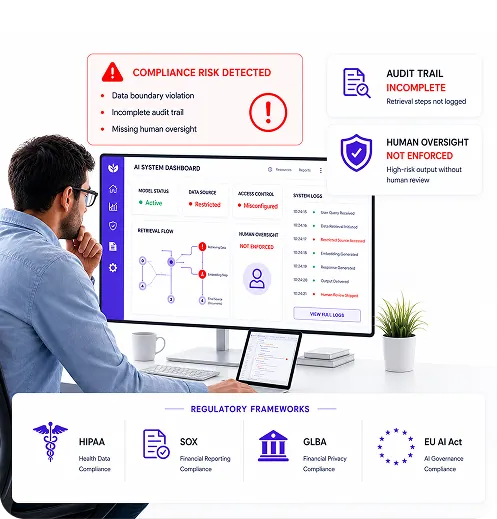

This is not an edge case. It is the most common AI compliance failure pattern in regulated industries.

The system was built by engineers who understood AI, but not compliance architecture.
Compliance-safe AI starts with the architecture. Not the audit.
Six Ways AI Systems Fail Regulatory Review

Data boundary violations
PHI, PII, or financially regulated data routed through third-party model APIs without the contractual and technical safeguards the regulatory framework requires. Often introduced during prototyping and never remediated before production.

Audit trail gaps
Systems that log inputs and outputs, but not intermediate reasoning steps, retrieval events, or the specific model version that produced a given output. Sufficient for operational monitoring, insufficient for regulatory examination or legal discovery.

Access control at the wrong layer
Role-based access is enforced at the presentation layer rather than the data and retrieval layer. A user without clearance sees a filtered interface, but the underlying query retrieved restricted data. In HIPAA and privilege-governed environments, this is a material compliance failure regardless of what appeared in the output.

Absent explainability architecture
Model outputs with no factor attribution and no source citation. Under the EU AI Act high-risk system requirements and FFIEC model risk management guidance, this is not a documentation gap; it is an architectural non-compliance.

Prompt injection exposure
Systems accepting user input passed directly into model prompts without sanitization, validation, or isolation. In multi-tenant environments or systems processing adversarial inputs, this is an active attack surface.

No human oversight enforcement
Systems designed to route all outputs to automated downstream processes without a structured human review stage for outputs above a defined consequence threshold. For high-risk AI systems under the EU AI Act, human oversight is a legal requirement, not a best practice.
The Compliance–Safe AI Standard
8 Architectural Requirements
Applied to every EPixelSoft engagement in a regulated vertical. Also available as a standalone hardening engagement.

PHI, PII, and financially sensitive content are processed only within architecturally isolated environments. Third-party API calls only under appropriate BAAs, DPAs, and data classification.

Role-based access is enforced at the data and retrieval layer, not the presentation layer. The restriction is architectural.

Every query, retrieval event, model call, intermediate reasoning step, output, and human override is logged with a timestamp, user identity, model version, and input hash. Immutable, queryable, retained per regulatory requirement.

Every model output surfaced with contributing factors, their weights, and source documents. Satisfies both operational and regulatory review requirements.

Input sanitization, prompt structure isolation, output validation, and adversarial input testing against OWASP LLM Top 10 attack patterns before production deployment.

Structured human review stages for outputs above a defined consequence threshold. Documented escalation logic and override recording.

Every model update, prompt change, and retrieval configuration change is version-controlled and subject to production change approval. Rollback capability maintained.

Documented procedures for model output failures, data boundary violations, and adversarial events, including notification timelines under HIPAA Breach Notification, GDPR Article 33, and applicable state laws.
How EPixelSoft Applies It

For new builds: Compliance–Safe AI standard applied from the architecture design phase. Data classification, access control design, audit trail specification, and explainability architecture are defined before the first line of code and reviewed at each stage gate.

For existing deployments: EPixelSoft conducts a compliance architecture review, a structured assessment against the 8 requirements above, and produces a gap analysis with a prioritized remediation roadmap.
Standard deliverables in both cases:
 Model cardCompliance architecture documentAudit trail specification
These are the three documents most frequently requested during regulatory examinations and legal discovery.

Standalone Hardening
Standalone Hardening for Existing Deployments
AI system already in production and facing a compliance review, a regulatory examination, or legal team questions that the original vendor cannot answer?
EPixelSoft offers a standalone hardening engagement:

Compliance architecture review (2–3 weeks)
Data that looks clean in aggregate, and breaks on the edge cases that matter

Prioritized remediation build
scoped against the gap analysis findings
Most common remediation priorities:


Vertical Compliance Requirements

HealthTech
PHI handling, audit requirements, breach notification, BAA coverage for every third-party service in the data flow. Audit trail retention: 6 years minimum.

FinTech
Explainability and human oversight requirements for automated credit decisions affecting individuals.

LegalTech
Architectural isolation preventing inadvertent disclosure through retrieval, logging, or third-party API routing.

InsurTech
Audit trails for pricing and underwriting decisions subject to regulatory examination in most US jurisdictions.

Talk to a Compliance Architect
The conversation covers the current system, the regulatory frameworks in scope, and the specific compliance concerns that have surfaced, whether from an internal review, a legal team question, or an upcoming regulatory examination.
Building new AI in a regulated vertical and want compliance designed in from the start?