

 AI DECISION INTELLIGENCEAI Decision Intelligence
You Have the Data. Your Team Still Makes Decisions the Same Way
Decision intelligence converts operational data into confidence-scored, source-attributed recommendations, delivered to the right person, at the right point in the workflow, in a form they can act on and a regulator can review.
PROBLEM STATEMENT
The Gap Between Data and Decisions
Today's Reality
The Head of Underwriting has access to more data than any previous generation of underwriters.
 Loss history
 Exposure models
 Third-party risk scores
 Prior claims patterns
Her team built a BI dashboard 18 months ago. Three people look at it regularly. It has not changed how underwriting decisions get made.
The problem is not the data. The problem is not the model.
It is the gap between a dashboard that presents information and a system that delivers a decision-ready signal at the moment the underwriter needs it.
A chart showing loss ratios by segment is information.
A confidence-scored recommendation, this account sits in the 87th percentile of loss probability for its class, driven by three specific factors sourced from these documents, is a decision-ready signal.
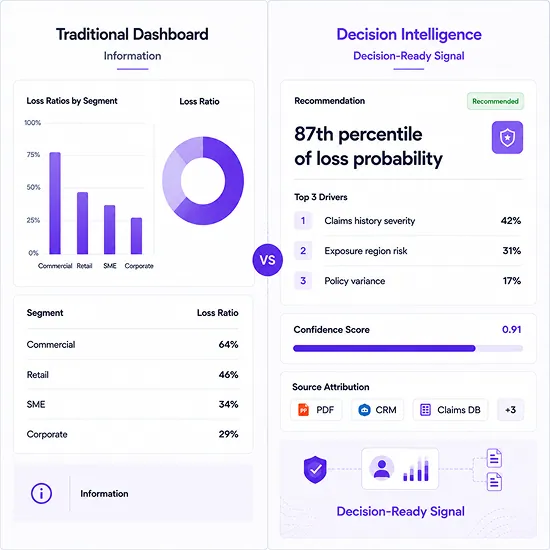

The difference between the two is not a visualization problem.
It is an architectural problem.

Why Dashboards Have Not Solved This
Three structural reasons BI platforms fail to close the data-to-decision gap

Dashboards are pull systems
The decision-maker has to go to the dashboard, interpret what they see, and translate it into a decision. In high-volume regulated workflows, there is no time for that translation in every case. The signal needs to come to them, shaped to the specific decision at hand.

Dashboards surface correlation, not attribution
Decision-makers in regulated environments need to document their reasoning. Not "loss ratios are elevated", but "this account's loss probability is elevated because of these three factors, weighted as follows, sourced from these documents." Attribution is what makes a decision defensible under regulatory review.

Dashboards have no confidence layer
Every chart looks equally authoritative whether the underlying data is complete or sparse. A decision intelligence system surfaces data quality and model confidence as first-class signals, so the decision-maker knows when to act and when to investigate further.
What Decision Intelligence Actually Requires
Four engineering components, in combination, produce decision-ready intelligence from operational data.

Signal Extraction & Enrichment
Structured and unstructured data pulled from operational systems, LOS, claims management, EMR, CRM, cleaned, normalized, and enriched with third-party signals where the decision warrants it. Handles schema complexity of legacy systems and format variance of document-heavy inputs.

Model Layer with Confidence Scoring
Predictive and classification models calibrated for the specific decision domain. Outputs carry explicit confidence scores, a first-class signal that drives downstream routing and presentation logic, not a metadata field.

Explainability Layer
Every recommendation surfaces:

The factors that drove it
Their contribution weights
Source attribution to the documents or data points that anchored the reasoning
Designed for two audiences simultaneously: the decision-maker who needs to act in 30 seconds, and the compliance officer who may need to reconstruct the reasoning 12 months later under regulatory examination.

Decision Surface Integration
Intelligence is delivered into the workflow at the point of decision, in the case management interface, the underwriting queue, and the clinical review list, where the decision is actually being made. Not in a separate dashboard that the user has to open.
Where This Has Shipped

FinTech, Credit Decisioning Intelligence
Underwriters received confidence-scored credit signals with factor attribution and source document links for each application before beginning their review. Senior underwriters reported the intelligence layer surfaced risk factors they would have identified eventually, and several they hadn't been monitoring systematically.
Decision consistency across the underwriting team improved measurably in the first quarter post-deployment.
US commercial lender. Named client reference available on request.

InsurTech, Claims Decision Support
Confidence-scored liability assessments with coverage verification and comparable prior claims attribution delivered to adjusters at case assignment.
Average time-to-first-decision reduced by 38%
Escalation rate to senior adjusters for straightforward cases reduced by 51%, concentrating senior capacity on genuinely complex claims
State regulatory examination of the decision trail was completed without findings

HealthTech, Clinical Operations Intelligence
Patient risk stratification with factor attribution and protocol citations delivered to clinical reviewers within their existing interface.
System surfaces patients in the top decile of readmission risk, the factors driving the classification, and specific protocol recommendations applicable to each factor.
Documented reduction in preventable readmissions within two quarters of deployment.
Engagement Model
Timeline: 10–16 weeks depending on source data environment complexity, number of decision types in scope, and integration requirements.

Weeks 1–3
Signal extraction, data readiness assessment, model scoping
Weeks 4–12
Model development, explainability architecture, decision surface integration
Final weeks
Production deployment, eval infrastructure, regulatory documentation

Deliverables: Production system · model documentation suitable for regulatory review · explainability output specifications · integration documentation · eval infrastructure for ongoing accuracy and confidence calibration monitoring.

Is This the Right Fit?
GOOD FIT IF

High-volume decisions are currently made manually or semi-manually, including underwriting queues, claims pipelines, and clinical review lists
Decision quality, consistency, and auditability are measurable business objectives
Sufficient historical decision data to calibrate the model layer
Built AI with another vendor and discovered the operational gaps that emerge without structured post-deployment monitoring
NOT A FIT IF:

The primary bottleneck is workflow structure, not decision signal quality → Cognitive Workflow Re-Architecture
Not yet sure where decision intelligence would have the most impact → AI Readiness Audit first

Book a Decision Intelligence Briefing
The briefing covers the target decision domain, current data environment, explainability and regulatory requirements, and integration architecture. Most clients arrive with a specific workflow in mind and a clear sense of what good decision support would change.
Already running predictive models in production that need monitoring and drift detection?