

 AI TRANSFORMATIONAI Transformation
The Workflow AI Hasn't Been Able to Touch, Until Now
For underwriting, claims adjudication, and prior authorization workflows that have survived RPA, rules engines, and LLM pilots, and still run manually. EPixelSoft decomposes every decision node and rebuilds the workflow around what AI should and shouldn't do.
A Pattern That Repeats Across Every Regulated Industry
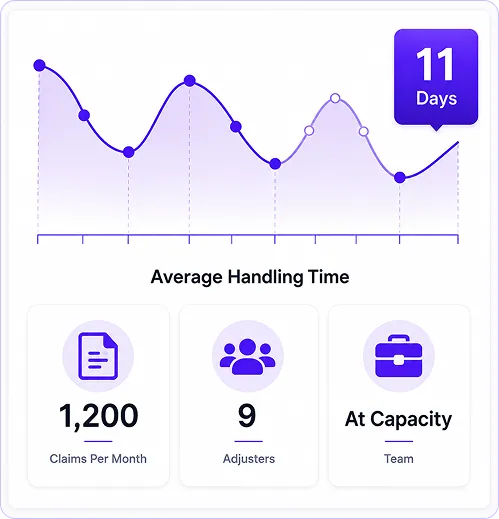
A commercial insurer processes 1,200 claims per month across nine adjusters. Average handling time: eleven days. Team at capacity. Backlog growing every quarter.
PROBLEM STATEMENT
Rules engines and RPA succeed on the deterministic, well-bounded subset of a workflow. In judgment-heavy regulated workflows, that subset is typically 15–30% of volume. The remaining 70–85% involves conditional reasoning, document interpretation, and exception handling that rules cannot capture.
Three automation attempts in two years:

A rules-based tool that broke whenever the payer changed a form
An RPA implementation that lasted eight months before maintenance costs exceeded the savings
An internal LLM pilot that compliance refused to approve, no explainability, no audit trail
The workflow is still eleven days. The team is still at capacity.
This pattern is consistent across FinTech, HealthTech, and InsurTech. The workflow isn't too complex for AI. It was never built correctly for AI.
Why Prior Attempts Failed
A commercial insurer processes 1,200 claims per month across nine adjusters. Average handling time: eleven days. Team at capacity. Backlog growing every quarter.

Rules engines and RPA succeed on the deterministic, well-bounded subset of a workflow. In judgment-heavy regulated workflows, that subset is typically 15–30% of volume. The remaining 70–85% involves conditional reasoning, document interpretation, and exception handling that rules cannot capture.
Single-prompt LLM approaches treat the entire workflow as a single inference problem. The model handles average cases, and fails silently on exceptions.
In regulated industries, that is worse than no automation at all:
The Decomposition Method
Cognitive workflow re-architecture begins before any code is written.
EPixelSoft maps the workflow at the decision node level, not the process level. Every step where a judgment is made is identified, described, and classified into one of four treatments:


The decomposition map is the deliverable that precedes the build. Clients review, challenge, and sign off before engineering starts. It is also the document that satisfies model risk management review in regulated environments.
How EPixelSoft Builds It

Orchestration
LangGraph State management across multi-step agent sequences, branching logic, conditional routing between deterministic and agentic nodes, and durable execution for workflows spanning hours or days.

Retrieval layer
Built on EPixelSoft's Vertical RAG architecture where the workflow requires document access, policy documents, regulatory guidelines, prior case history. Role-based access enforced at the retrieval layer.

Eval infrastructure
Each decision node has an independent eval set. The system is not evaluated as a whole, it is evaluated node by node. Accuracy thresholds set per node based on the consequence of an error at that step.
Where the Audit Has Surfaced Opportunity

Commercial Loan Underwriting

Decomposition map satisfied model risk management review without modification.

Claims Adjudication

Prior Authorization
Engagement Model
Timeline: 12–20 weeks depending on workflow complexity, decision node count, and integration requirements.

Weeks 1–4
Workflow mapping, decomposition, client sign-off
Weeks 5–16
Build and staged testing per decision node
Final weeks
Production deployment, 30-day live monitoring

Deliverables: Decomposition map · production system · per-node eval infrastructure · integration documentation · model risk management brief suitable for regulatory review.

Is This the Right Fit?
GOOD FIT IF

High-volume, judgment-heavy workflow with at least one failed automation attempt
Business impact of cycle time reduction or capacity increase is clearly quantifiable
Operating in FinTech, InsurTech, HealthTech, or LegalTech
NOT A FIT IF:

Haven't identified which workflow to prioritize → AI Readiness Audit first
Primarily document routing or data extraction with limited conditional judgment → AI Workflow Automation

Schedule a Workflow Decomposition Review
Bring the workflow: volume, current cycle time, the team it runs through, and prior automation attempts. EPixelSoft will map the decision nodes, identify the decomposition pattern, and confirm fit, before any commitment is made.
Already past the build?