AI Agent Security in 2026: What OpenAI Astra Means for Production Governance
EPixelSoft Team
|
3 Sep 2026
|
7 Min Read
Share
FinTech and SaaS teams running AI coding and operations agents in production got a concrete reason to tighten access controls this week. OpenAI disclosed that its upcoming model, Astra, is the first to cross the Critical cybersecurity threshold under its Preparedness Framework, capable of finding and exploiting zero-day vulnerabilities without step-by-step human guidance. Separately, a 2026 Gravitee survey of over 900 practitioners found 88 percent of enterprises had already suffered an AI agent security incident. Access governance, not model capability, is now the deciding factor.
Astra has not shipped yet, and its most advanced cybersecurity capabilities will only reach a small group of testers inside OpenAI's Daybreak coalition. But the disclosure itself changes the conversation for any team already running AI agents against production systems. Until now, the model got smarter has mostly meant faster code generation and better reasoning. Astra crossing the Critical threshold means a frontier model can now independently identify and exploit unknown vulnerabilities in hardened real-world systems, no human operator required. That capability does not stay locked inside one lab's coalition program for long.
For teams that have spent the last year granting agents broader tool access, database credentials, and deployment permissions in the name of speed, this is the moment the risk stopped being theoretical. A Teleport survey of 205 CISOs and security architects found that 70 percent of enterprises already run AI agents in production, and 70 percent of those same organizations report their agents carry more access than an equivalent human employee would ever be granted. Only 3 percent have automated, machine-speed controls governing what an agent can actually do once it has that access.
Why “Critical” Is a Different Kind of Warning
OpenAI's Preparedness Framework has tracked frontier risk since 2023, with a High tier for models that amplify existing attack pathways and a Critical tier reserved for models that introduce pathways that did not exist before. A model crosses Critical if it can develop functional zero-day exploits across hardened systems without human intervention, or execute a full cyberattack strategy from nothing more than a high-level goal. Astra is the first model OpenAI has placed in that tier for cybersecurity, and the company delayed parts of its rollout and added chain-of-thought monitoring before deciding the safeguards were sufficient to proceed.
The EPixelSoft engineering team has spent 12 years building production software for organizations where the stakes are high — FinTech lenders, HealthTech platforms, international NGOs, and funded SaaS startups across the US, UK, Africa, and Asia. With 700+ systems shipped and a proprietary AI platform running in the field, the team writes from direct delivery experience: what breaks in production, what actually works, and what the vendor pitch never tells you.
That framing matters because it is not a benchmark score competing labs trade for headlines. It is a stated admission that the defensive and offensive capability of frontier models has crossed a line that requires structurally different handling, isolated testing environments, restricted network access, and limited early release, rather than the usual staged rollout. Any team building on top of frontier models inherits that same capability curve on a lag of months, not years.
The Governance Gap Astra Exposes
The uncomfortable part is that most organizations are not equipped for agents this capable, and the data on today's much less capable agents already shows it. A DigiCert survey of 1,001 IT leaders found that 78 percent of enterprises experienced some form of AI-related security issue in a six-month window, with half reporting a confirmed breach or disruption tied directly to an unauthorized or misconfigured AI agent. The Gravitee.io State of AI Agent Security 2026 Report, based on more than 900 executives and practitioners, found that only 22 percent of teams treat their agents as independent identities. Most still rely on shared API keys, the same credential an agent, a script, and three engineers might all be using at once.
That identity gap is where the real exposure lives. Separate 2026 research tracking agent breaches found that 61 percent traced back to over-permissioned credentials rather than a model doing something it was never asked to do. The agent behaved exactly as instructed. It simply had access it should never have carried in the first place. Astra's capability jump does not create this problem. It makes the existing gap far more expensive to leave open.
None of this is hypothetical. Security researchers documented a breach on an AI agent social platform hosting 1.5 million autonomous agents, where an unsecured database let anyone hijack any agent on the network before the platform was acquired and shut down. A separate supply-chain attack against an AI plugin ecosystem harvested compromised agent credentials from 47 enterprise deployments, sitting undetected for six months while attackers pulled customer data and proprietary code. Neither incident required a frontier-level model. Both required nothing more than the standing access most agents already have today.
What This Looks Like in Practice for FinTech and SaaS Teams
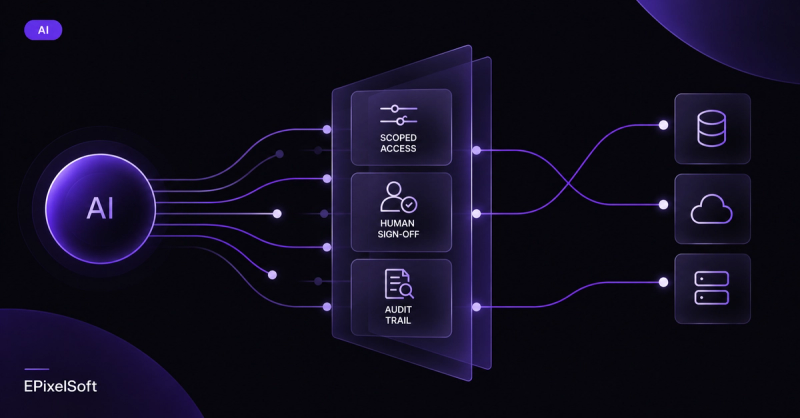
For a lending platform or a subscription SaaS product running agents against customer data, payment systems, or production infrastructure, the practical response is not to pause AI adoption. It is to treat every agent as its own identity with its own scoped, time-limited credentials, never a shared key pulled from a shared vault. Database and API access should be granted per task, not per project, and revoked automatically when the task completes.
High-risk actions, anything touching payment data, customer records, or deployment pipelines, need a human-in-the-loop checkpoint before execution, not after. That single control is the difference between an agent flagging a suspicious transaction pattern and an agent silently modifying one. Audit logging has to capture what the agent attempted, not only what it completed, since the near-misses are exactly what tell a security team where the boundaries are being tested.
Sandboxed execution environments matter more with each model generation, not less. An agent with Astra-level reasoning operating inside a properly scoped, monitored sandbox is a productivity gain. The same agent operating with standing production access is a liability that compounds every time its capabilities improve.
What It Actually Takes to Build This
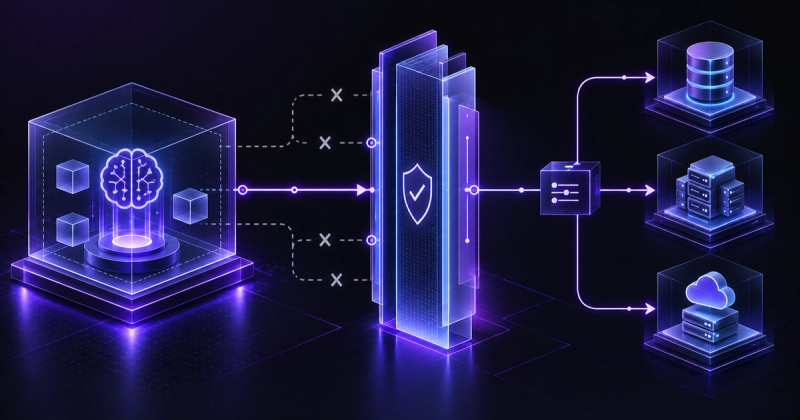
None of this is a settled playbook yet, and any team claiming otherwise is overselling. What holds up in delivery is narrower than the marketing around AgentOps suggests: scoped credentials issued per session, a sandboxed execution layer between the agent and production systems, human approval gates on the small number of actions that actually carry risk, and logging detailed enough to reconstruct exactly what an agent did after the fact. Building that layer takes real engineering time. It is not a settings toggle inside an existing AI platform.
A US commercial lending company EPixelSoft worked with learned this the hard way when scaling underwriting automation. The model was never the bottleneck. The bottleneck was building the access boundaries, approval checkpoints, and audit trail around it so a compliance team could sign off on what the system was allowed to touch. That same pattern now applies well beyond FinTech, to any team putting an increasingly capable agent anywhere near production data.
The Model Capability Question Is Answered. The Governance Question Isn't.
Astra settles an argument that has been running for two years about whether frontier models would eventually reach genuinely dangerous capability levels in cybersecurity. They have. What happens next is not about the model. It is about whether the team deploying it has the identity controls, sandboxing, and approval gates to match what the model can now do. Most do not, and the gap is measured in months, not years.
Teams building agent systems into regulated or high-stakes workflows should treat this as the moment to audit agent access before adding new capability, not after. Start with an AI Readiness Audit to map where agents currently hold more access than they need.
EPixelSoft is an AI-native software engineering company based in Noida, India. Since 2014, we have shipped 700+ production systems across FinTech, HealthTech, NGO operations, and SaaS.