AI Underwriting Automation for Lenders: Why the Bottleneck Isn't the Model


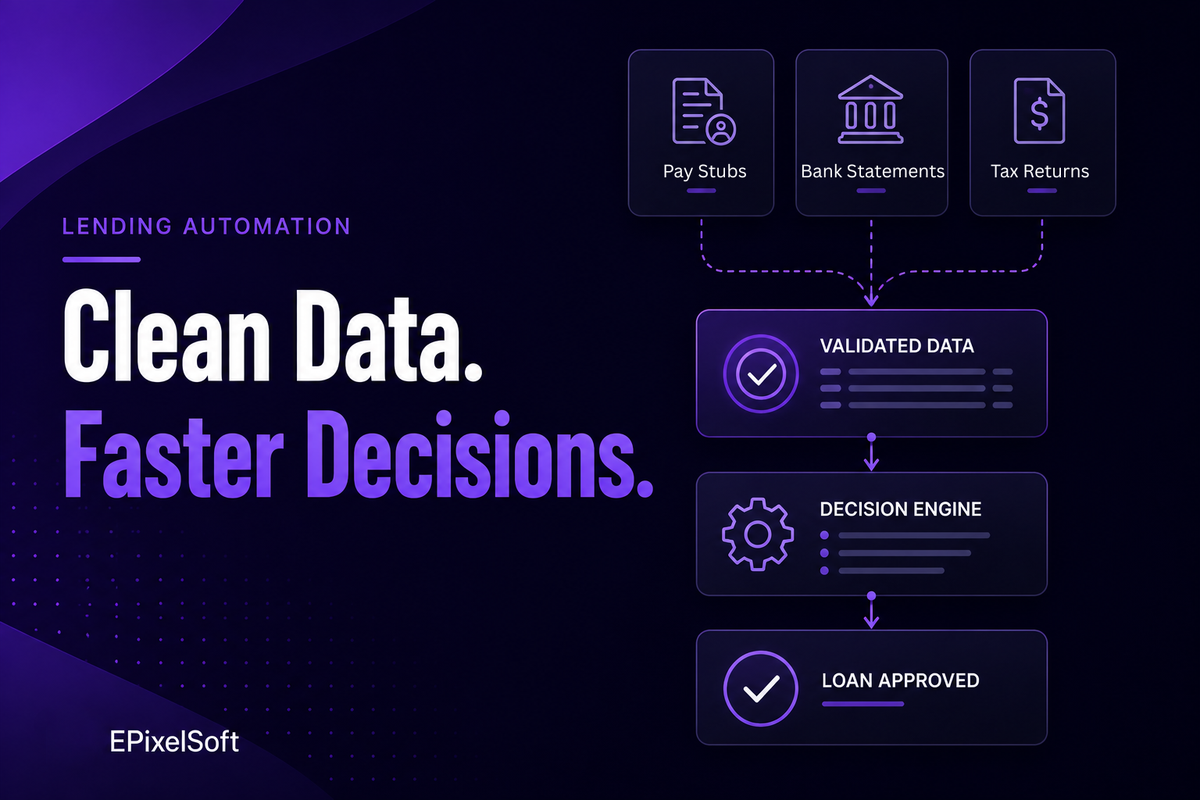
For commercial lenders and mortgage originators evaluating AI underwriting automation, the credit scoring model is rarely what slows a loan down. Analysts still lose four to six hours per deal reconciling income figures across pay stubs, bank statements, and tax returns before a scoring model ever runs. One US commercial lending platform cut that cycle four times over and increased revenue per analyst tenfold by rebuilding the document ingestion and normalization layer first.
That four to six hour gap is not a scoring problem. It is a data problem, and it exists before the credit decision ever begins. A loan file arrives as pay stubs, bank statements, tax returns, and disclosures, each formatted differently by every employer, bank, and jurisdiction, and someone has to reconcile them before any model, however sophisticated, has clean numbers to work with.
Most lenders start their AI underwriting project in the wrong place. They shop for a decisioning engine, a credit scoring model, or an agentic layer that promises to approve, decline, or refer a file automatically. That part of the system is genuinely mature now. According to McKinsey research cited in industry coverage, AI and automation could create $200 billion to $340 billion in annual value across banking operations, with lending and underwriting representing the largest share of that number. The model is not the problem. The problem is what feeds it.
Why buying a better model doesn't fix the queue
Lenders who deploy a modern decisioning layer while leaving document intake untouched tend to be disappointed by how little changes. According to Uptiq, generic AI and OCR tools plateau at 75 to 80 percent accuracy on financial documents, which produces enough errors that a human still has to check nearly every file. The result is a familiar pattern: the decisioning model runs in seconds, but the file sits in a queue for days because nobody trusts the numbers it was fed.
This shows up as a specific, measurable cost. Uptiq's research on commercial lending puts analyst time at four to six hours per deal on financial spreading and data entry alone, work that has nothing to do with credit judgment and everything to do with cross-referencing numbers across formats. TIMVERO reports that lenders who automate financial spreading and covenant monitoring see a 40 to 60 percent reduction in analyst time per commercial loan, but only when the extraction layer is treated as the primary engineering problem rather than a solved commodity.
About The Author

EPixelSoft Team
LinkedInThe EPixelSoft engineering team has spent 12 years building production software for organizations where the stakes are high — FinTech lenders, HealthTech platforms, international NGOs, and funded SaaS startups across the US, UK, Africa, and Asia. With 700+ systems shipped and a proprietary AI platform running in the field, the team writes from direct delivery experience: what breaks in production, what actually works, and what the vendor pitch never tells you.