Legacy System Modernisation: When to Rewrite, When to Wrap, and How to Know the Difference
EPixelSoft Team
|
6 Jul 2026
|
7 Min Read
Share
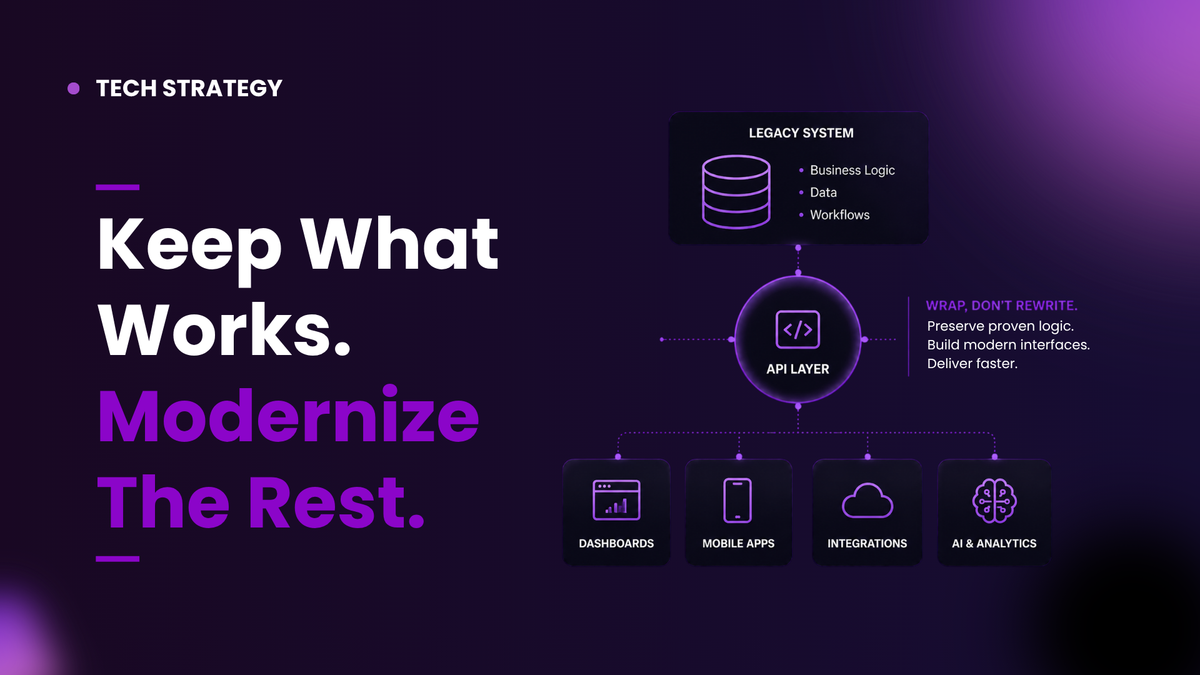
Legacy system modernisation for FinTech and SaaS companies comes down to one decision: rewrite or wrap. A full rewrite replaces the codebase entirely and typically takes 36 to 48 months before it generates a return. API wrapping builds a modern interface over existing logic, preserves battle-tested business rules, and can deliver production value in weeks. According to a 2025 survey of IT professionals, 62% of organisations still depend on legacy software — and most of them are making the wrong call based on the wrong criteria. The right answer is not architectural preference. It is a function of how tightly coupled your domain logic is, how much downtime you can absorb, and what the business actually needs the system to do next.
The conversation starts the same way almost every time. A CTO or VP of Engineering describes a system that is slowing the team down. Deployments take two days. A new integration requires touching code that nobody fully understands. A compliance change that should take a week is eating three sprints. And somewhere in that frustration, someone says: "We should just rewrite it."
That impulse is understandable. The appeal of a clean start is real. But the numbers do not support it as a default response.
Studies summarised in modernisation decision frameworks indicate that 60 to 80 percent of software rewrites either fail to deliver their expected benefits or are cancelled before completion. Those that do finish typically take two to three times longer than projected. The business case that was built on an 18-month timeline quietly becomes a 36-month one. Meanwhile, the system that was supposed to be replaced has been running in production the whole time, still processing payments, still closing loans, still doing the work.
Why the Default Framing Gets It Wrong
Most teams frame this as a technical question. Old technology vs. new technology. Monolith vs. microservices. PHP vs. Node. That framing is a distraction.
The actual question is about where the business logic lives and how much of it is still correct. Legacy systems accumulate two things over time: working domain logic that reflects real business rules built up over years, and structural debt that makes that logic hard to access, modify, or integrate with anything new. Those are different problems with different solutions.
A US commercial lending company we worked with had exactly this situation. Eight separate MySQL databases, built over a decade, each owning a different slice of the underwriting process. No unified API. No shared authentication. Analysts were manually moving data between systems to close a single loan file. The underwriting cycle was running at nine days. The instinct from the internal team was to rewrite everything into a new platform.
The EPixelSoft engineering team has spent 12 years building production software for organizations where the stakes are high — FinTech lenders, HealthTech platforms, international NGOs, and funded SaaS startups across the US, UK, Africa, and Asia. With 700+ systems shipped and a proprietary AI platform running in the field, the team writes from direct delivery experience: what breaks in production, what actually works, and what the vendor pitch never tells you.
The underlying credit logic was sound. The decisioning rules had been refined across thousands of real loan applications. A rewrite would have spent 18 months recreating logic that already worked correctly, at the risk of introducing subtle errors in edge cases that only surface three years later when a loan book goes wrong.
The Framework: Four Questions Before You Decide
Before touching the codebase, answer these four questions. They will determine which path makes engineering and business sense.
First: Is the domain logic still correct? If the system's core business rules are still valid and producing correct outputs, the problem is access and integration, not logic. Wrapping with an API layer solves that without touching what works.
Second: Can the system be decomposed into identifiable bounded contexts? If you can draw a clean boundary around a functional area — authentication, reporting, payment processing — you can migrate that area independently while the rest of the system continues to run. This is the foundation of the strangler fig approach: build the new implementation behind a routing layer, route traffic to it progressively, retire the legacy code once the new path is validated.
Third: What is the actual cost of downtime? In FinTech, the answer is almost always "more than the rewrite savings." A full rewrite requires either a hard cutover — going dark during migration — or running two systems in parallel until confidence is high enough to switch. Both are expensive. The strangler approach keeps the system revenue-generating throughout.
Fourth: Is this system blocking AI integration? The MuleSoft 2026 connectivity report found that 50 percent of AI agents operate in isolated environments, and legacy systems without modern API interfaces are a primary reason. If your modernisation goal includes AI readiness — feeding data into a scoring model, connecting to an external decisioning engine, enabling real-time fraud detection — the API layer is not just an interim measure. It is the architecture you need.
What API Wrapping Actually Looks Like in Production
Back to the lending company. Rather than rebuilding from scratch, we consolidated those eight MySQL databases into two PostgreSQL databases and built a Django REST API layer on top. A unified OAuth2 authentication model replaced the fragmented access patterns. The existing credit logic was not touched. What changed was how systems talked to each other.
The underwriting cycle dropped from nine days to 38 hours. Analyst throughput increased fourfold. Revenue per analyst went up tenfold. The project did not require a full rewrite of business logic that had been refined over years of real lending decisions.
This is what API wrapping delivers when the conditions are right. The legacy logic is stable. The problem is connectivity, data access, and the absence of a modern interface. A well-designed API layer solves all three without the risk profile or the timeline of a full rebuild.
The implementation follows a consistent sequence. First, expose the legacy system's core data through stable API endpoints. Second, introduce an integration layer that handles data transformation, authentication, and event routing between systems. Third, use feature flags to route traffic incrementally to new components, running old and new in parallel until confidence is high. Fourth, once a module is fully migrated and validated, retire the legacy code path.
When a Rewrite Is Actually the Right Call
There are situations where a rewrite is genuinely correct. Recognising them matters as much as knowing when to avoid one.
The clearest case: the architecture physically cannot support where the business needs to go, and no API layer changes that. If the core data model is incompatible with the new product direction — not just inconvenient, but structurally incompatible — wrapping delays the reckoning without solving it. Similarly, if the system is so tightly coupled that no component boundary can be drawn, the incremental approach cannot get started without first doing significant structural work. At that point, the cost comparison shifts.
A full rewrite is also defensible when the entire team that built the original system has left, documentation does not exist, and the codebase cannot be read with confidence. Institutional knowledge is architecture. When it is entirely gone, the cost of understanding the system well enough to wrap it safely may exceed the cost of rebuilding it with modern tooling.
The third case: the system is not in production and not business-critical. A decommissioned internal tool, a prototype that never scaled, an internal reporting system with a small user base. Here the risk profile of a full rewrite is manageable and the case for it can be reasonable.
Outside these three cases, incremental modernisation — API wrapping, the strangler fig pattern, phased migration — almost always delivers faster business value with lower execution risk.
The Hidden Cost That Drives Bad Decisions
Enterprises currently spend between 60 and 80 percent of IT budgets maintaining existing systems, leaving under 30 percent for new capability development. That ratio is the real argument for modernisation. But it does not automatically become an argument for a full rewrite.
McKinsey's 2026 research documents 30 to 50 percent infrastructure cost reductions following modernisation, alongside 20 to 30 percent improvements in development cycle times. Those numbers apply to modernisation broadly, not exclusively to full rewrites. Organisations that modernised applications on mainframe infrastructure, rather than replacing mainframe entirely, achieved a 288 percent ROI according to Kyndryl's 2025 State of Mainframe Modernisation survey. The direction of travel is consistent: targeted modernisation, focused on the highest-friction areas first, returns positive ROI in 12 to 14 months. Full rewrites typically take 36 to 48 months before they generate a return.
There is also a talent cost that rarely appears in modernisation budgets. COBOL developers, according to CARITech's 2025 analysis, cost between $200 and $250 per hour compared to $90 per hour for engineers working on modern stacks. That pool is shrinking as the engineers who know the systems retire. Waiting to modernise does not preserve optionality. It reduces it.
Start With the Audit, Not the Architecture Decision
The organisations that get this right do not start by choosing between rewrite and wrap. They start by understanding what the system actually does, which parts of it are still correct, and where the friction is most expensive.
A proper technical audit maps the system's components, documents the business logic buried in the code, identifies the highest-risk integration points, and produces a ranked list of where modernisation effort returns the most value. That inventory drives the decision. Not architectural preference. Not what the new engineering hire used at their last job.
The teams that get into trouble are the ones that commit to a modernisation path before that inventory is complete. They choose an approach based on how the old system feels to work in, not what the system actually needs. The result is strategy drift: scope changes to cope with delivery pressure, the original success criteria stay fixed, and the gap between what was planned and what is being built widens quietly for months.
The modernisation decision is not a technical one. It is a business decision that requires technical input. Make it on evidence.
If you are evaluating a modernisation path for a live system, our AI Readiness Audit starts with the inventory, identifies where wrapping delivers faster value than rebuilding, and produces a decision-ready report. Reach us at epixelsoft.com/contact.
EPixelSoft is an AI-native software engineering company based in Noida, India. Since 2014, we have shipped 700+ production systems across FinTech, HealthTech, NGO operations, and SaaS.