What Enterprise AI Transformation Actually Requires (And Why Most Programs Stall Before They Start)
Anil Kothiyal
|
2 Jun 2026
|
7 Min Read
Share
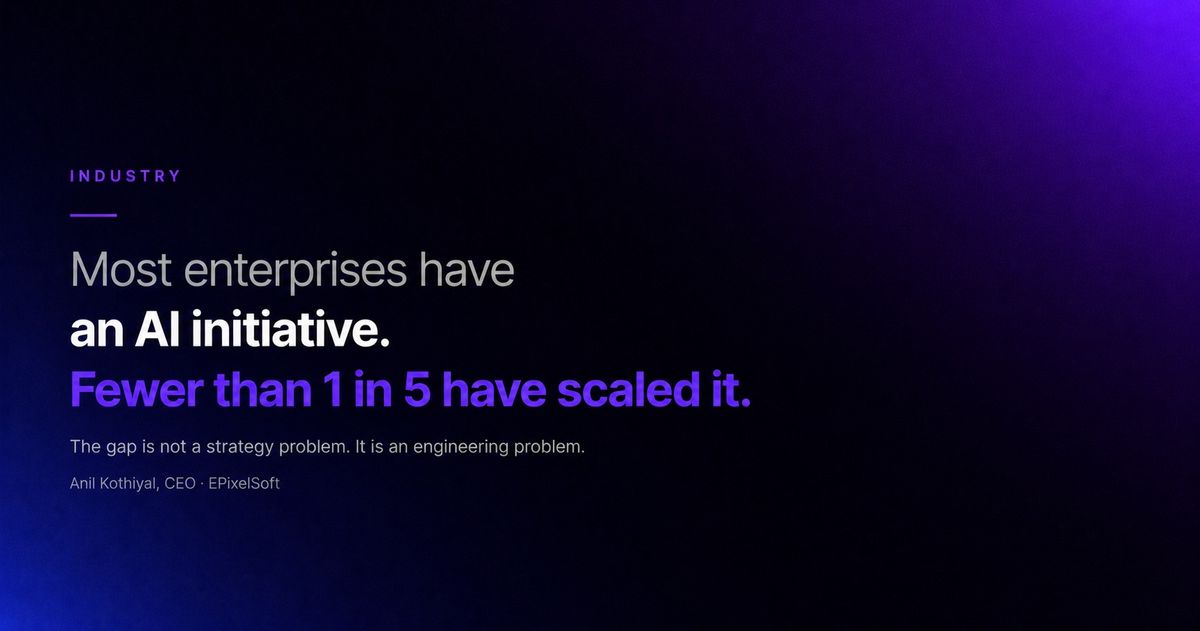
Enterprise AI transformation is the most discussed and least well-defined initiative in technology right now. Nearly every organization has an AI initiative. Fewer than one in five has scaled it into production. The gap between those two facts is not a strategy problem. It is an engineering problem that strategy conversations keep talking past.
According to McKinsey, nearly nine in ten organizations now regularly use AI in some form. Fewer than 20 percent have successfully scaled beyond pilots. A 2025 study by MIT's NANDA initiative concluded that 95 percent of generative AI pilot programs fail to produce measurable financial impact. The researchers were direct about the cause: the failures stem not from model quality but from poor workflow integration and misaligned organizational incentives.
Most organizations experiencing this pattern know the symptoms. The pilot performs well in a controlled environment. Stakeholders are encouraged. The project moves to production. Six months later it is quietly deprioritized because the output does not connect to the workflows where decisions are actually made. The model was not the problem. The integration was.
What Enterprise AI Transformation Is Actually Measuring
The Deloitte State of AI in the Enterprise 2026 report surveyed 3,235 senior leaders across 24 countries. Worker access to AI rose 50 percent in 2025. But only 34 percent of those organizations are genuinely reimagining their business. The other 66 percent are adding AI tools to processes that remain structurally unchanged.
This is the distinction that matters. Adding AI to an existing workflow accelerates what was already happening. Transforming a workflow around AI changes what is possible. A document review tool that speeds up a compliance analyst by 30 percent is useful. A re-architected underwriting process where AI handles document extraction, scoring, and audit trail generation in parallel — instead of serially — compresses a nine-day cycle to 38 hours. One is optimization. The other is transformation. The difference is in how deeply the AI is woven into the process architecture, not in which model is running.
Publicis Sapient's 2026 Global Enterprise AI Report captured this gap precisely: 73 percent of enterprises say AI is used regularly or across most business processes, but only 10 percent describe AI as core to how their business operates. That 63-point gap is, as their research noted, not a technology problem. It is an organizational one.
Anil Kothiyal is the Founder and CEO of EPixelSoft, an AI-native software engineering firm with 12 years and 700+ products shipped across FinTech, HealthTech, NGO operations, and SaaS. He has led engineering engagements for clients across the US, UK, Africa, and Asia — including platforms that compressed underwriting cycles from days to hours and field reporting systems deployed in East Africa. Anil writes about AI in production, high-stakes software delivery, and what it actually takes to build systems that hold up at scale.
Three Engineering Decisions That Determine Whether Transformation Happens
The failure pattern in enterprise AI is consistent enough that it resolves to three engineering decisions made early, often under time pressure, that define the ceiling for everything that follows.
The first is data architecture. Gartner projects that 60 percent of agentic AI projects will fail in 2026 due to lack of AI-ready data. This is not a prediction about future projects. It is an observation about the current state of most enterprise data environments. AI models do not fail because they are poorly designed. They fail because the data fed into them is inconsistent, siloed, or lacks the provenance required to make model outputs trustworthy in production. Getting data architecture right before model deployment is not preparatory work. It is the transformation work. The model is the last step, not the first.
The second is workflow integration depth. A model that produces a recommendation which then requires a human to manually copy data into another system is not a transformed workflow. It is a smarter version of the same bottleneck. Transformation requires that AI output connects directly to the downstream system that acts on it. That means API design, event-driven architecture where appropriate, and explicit decisions about where human review gates sit in the process. These are engineering decisions, not strategic ones.
The third is governance design. RAND Corporation's 2024 research across failed AI projects found that 84 percent of failures were attributable to leadership decisions rather than technical limitations. The dominant pattern was not bad models but absent accountability: no defined owner for AI output, no escalation path when the model produced an unexpected result, no measurement framework that tracked business outcomes rather than model metrics. Governance is not a compliance layer added after the system ships. It is the mechanism that determines whether AI output can be trusted and acted on at scale.
Why the Audit Starting Point Works
The most consistent failure in enterprise AI transformation is sequencing: organizations select a model before they understand the process they are transforming. The model becomes the answer to a question that has not been fully asked. Six months later, the question turns out to have been wrong.
The better sequence starts with an AI readiness audit: a structured assessment of the data environment, the current workflow architecture, and the integration surfaces available before any model selection or build decision is made. This produces a clear picture of which processes have the data density and integration maturity to support genuine transformation, versus which ones would produce an accelerated version of what already exists.
The distinction matters commercially. A process with thin, inconsistent, or unstructured data is not a candidate for transformation in its current state. An organization that has not yet defined accountability for AI output is not ready to expand AI autonomy, regardless of the model's capability. An audit surfaces these constraints before they become expensive production discoveries.
What Transformation Looks Like When It Works
The difference between AI-augmented and AI-transformed is most visible in cycle time and decision ownership. In a transformed workflow, decisions that previously required sequential human review — document in, analyst reviews, analyst decision, system updated — become parallel: AI extracts, scores, and flags simultaneously while a human reviews exceptions rather than every instance.
For a US commercial lending company, the original underwriting workflow ran analyst document processing, credit scoring, decision generation, and audit trail creation as a serialized queue. The architecture change — consolidating data into two unified databases, designing an API layer that ran these processes in parallel, and building the audit trail into the data model rather than as a reporting afterthought — produced a cycle time of 38 hours against a previous baseline of nine days. The AI did not replace the analyst. It changed what the analyst was reviewing. That is transformation.
The organizations that achieve this are not those with the most sophisticated models. They are the ones that did the process redesign before the model selection, designed the data architecture before the deployment, and defined governance before the first exception arrived in production.
The Agentic AI Question Every CTO Is Now Asking
Agentic AI — systems that execute multi-step workflows with minimal human intervention — is where enterprise AI investment is concentrating in 2026. The Deloitte research noted that only one in five companies has a mature governance model for autonomous agents. That is not a technology gap. Organizations are deploying autonomous decision-making capacity into workflows that do not have the accountability structures to manage it.
The practical question for any organization evaluating agentic AI is not which agent framework to build on. It is: what is the escalation path when the agent produces a result outside expected parameters, and who owns that outcome? Deloitte's research was direct on this point — unclear accountability will not scale. Ownership should be explicit before autonomy expands.
For FinTech, HealthTech, and InsurTech organizations operating in regulated environments, this question is not optional. A model that makes a credit decision, a clinical recommendation, or an insurance underwriting call without a traceable accountability chain is a regulatory exposure, not an efficiency gain. The governance architecture is the transformation work.
Where to Start
The organizations pulling ahead in enterprise AI are not the ones with the largest AI budgets or the most ambitious transformation charters. They are the ones that identified one high-value workflow, understood its data environment and integration surface completely, redesigned the process around AI capability, and shipped into production before expanding. That first deployment is also the organizational proof of concept for the governance model, the measurement framework, and the accountability structure that every subsequent deployment will depend on.
The strategy questions — which verticals to prioritize, which capabilities to build versus buy, how to sequence the investment — are real. But they do not determine whether transformation happens. The engineering decisions do.
If your organization is working out whether it has the data readiness, workflow architecture, and governance infrastructure to support genuine AI transformation, EPixelSoft's AI Readiness Audit is the structured starting point. We assess what exists, identify where the gaps are, and define the build sequence before any model decisions are made.
EPixelSoft is an AI-native software engineering company based in Noida, India. Since 2014, we have shipped 700+ production systems across FinTech, HealthTech, NGO operations, and SaaS.