Legacy System Modernization: How to Decide Between Refactor and Rebuild
EPixelSoft Team
|
10 Jun 2026
|
7 Min Read
Share
Legacy system modernization is the process of updating, restructuring, or replacing outdated software to meet current performance, security, and integration requirements without discarding the business logic accumulated over years of real use. For most mid-market and enterprise engineering teams, the decision is not whether to modernize but which systems to refactor, which to rebuild, and how to structure the work so delivery does not stop while the foundation is changing underneath it. Getting that call wrong costs more than the modernization itself.
The numbers describe the pressure clearly. Gartner, Forrester, and Deloitte consistently place legacy maintenance at 60 to 80 percent of total IT spend across enterprise portfolios. A 2025 GAO report on US federal IT spending found 79 percent of a $105 billion annual IT budget allocated to operations and maintenance of aging systems. According to a Stripe survey of developers, the average engineer spends 13.5 hours per week addressing technical debt, with self-reported estimates of wasted time running closer to 17 hours. Those are hours not spent building the features that generate revenue.
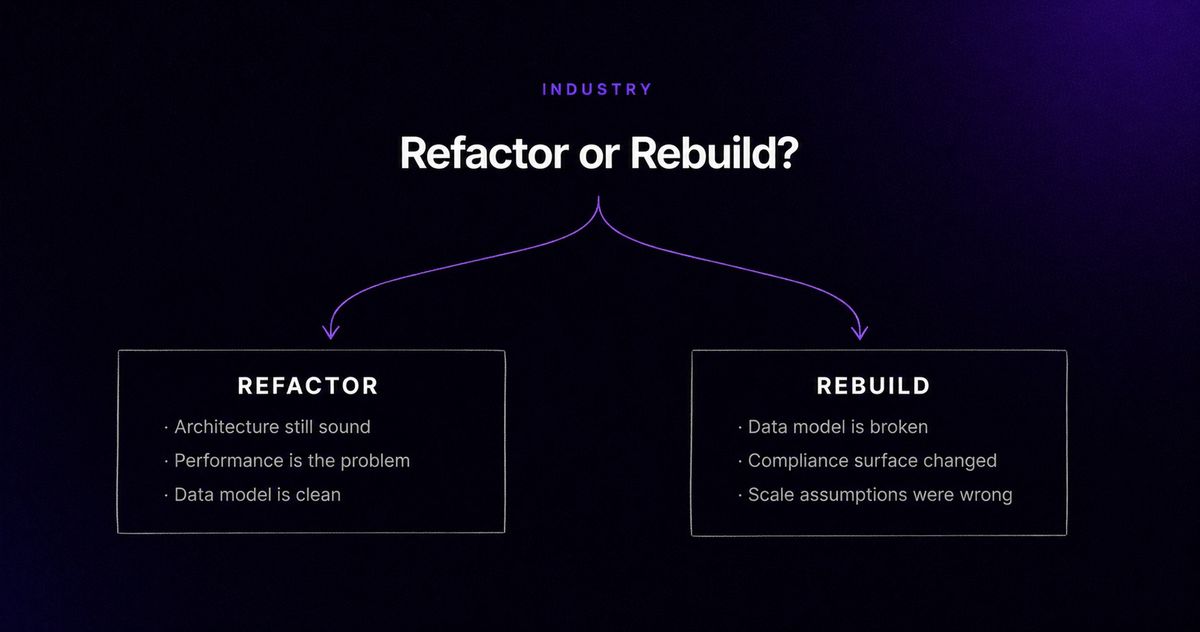
The decision that most teams get wrong is not the destination. It is the path. Refactoring a system that should be rebuilt wastes six to twelve months discovering the architectural constraints that made refactoring the wrong choice. Rebuilding a system that could have been refactored spends three times the budget for an outcome a more surgical approach would have achieved. The diagnostic question is not which option is cheaper. It is which option matches the actual condition of the system.
Why the Refactor vs Rebuild Decision Is Harder Than It Looks
Legacy system modernization refers to the deliberate process of updating aging software infrastructure through one or more of several approaches: refactoring the codebase for improved structure, rearchitecting for cloud-native or modular patterns, or rebuilding specific systems from scratch while preserving core business logic. For CTOs and engineering leaders, the stakes of choosing the wrong path are significant because each approach has a fundamentally different risk and cost profile. Refactoring preserves continuity but cannot escape the original architecture. Rebuilding offers a clean foundation but requires a period of parallel operation and careful cutover.
Most teams approach this decision with a cost-first frame: refactoring looks cheaper on paper because the scope appears smaller. That is the mistake. Refactoring is cheaper when the underlying architecture is sound and the problem is accumulated cruft. It becomes significantly more expensive than rebuilding when the architecture itself is the problem, because every change made within a broken structural model hits the same constraints. Forrester's Application Modernization research found that rebuilds achieve 67 percent better performance improvements compared to refactoring efforts when the original system carries significant architectural debt. The performance gap is not a product quality difference. It is an architecture difference.
The EPixelSoft engineering team has spent 12 years building production software for organizations where the stakes are high — FinTech lenders, HealthTech platforms, international NGOs, and funded SaaS startups across the US, UK, Africa, and Asia. With 700+ systems shipped and a proprietary AI platform running in the field, the team writes from direct delivery experience: what breaks in production, what actually works, and what the vendor pitch never tells you.
In 2026, legacy maintenance costs are rising 18 to 25 percent annually according to industry analysis, driven by developer scarcity in aging technology stacks, security exposure from unsupported architectures, and compliance requirements that now treat architectural obsolescence as a reportable audit finding under updated SOC 2 and ISO 27001 standards. The argument for delay is weaker than it has ever been.
The Four Signals That Mean Refactoring Will Fail
Not every legacy system is a rebuild candidate. The systems that should be refactored are those with viable architecture, reasonable test coverage, and bounded technical debt. The systems where refactoring will fail have a different profile, and the signals are consistent enough to recognize before the work starts.
Tight coupling with no clear seams. When every module in a system depends on every other module, there is no safe place to begin incremental improvement. Refactoring requires boundaries: a place where one component ends and another begins, where a change can be tested in isolation before it touches the rest of the system. Tightly coupled systems offer no such boundaries. Every change carries blast radius that is impossible to fully map, and the risk compounds with each incremental improvement. The Strangler Fig pattern, the most proven approach for incremental modernization, explicitly requires seams it can intercept. Without them, the pattern cannot be applied.
Zero or near-zero test coverage. Refactoring without tests is not refactoring. It is rewriting without feedback. The only way to know that a change preserved existing behavior is to have tests that verify existing behavior. Systems with insufficient test coverage cannot be safely refactored at any meaningful pace, and adding test coverage to a tightly coupled system first requires decoupling it — which is itself a refactoring project. Teams that attempt refactoring without this foundation discover the constraint at the worst possible time: in production.
A domain model that is fundamentally broken. Some legacy systems have architectural debt that goes deeper than the implementation. The way the system models the business domain, the entities it recognizes, the relationships it tracks, the workflows it supports, reflects decisions made when the business operated differently. When the domain model no longer matches the business reality, refactoring the code cannot fix the mismatch. The new requirements will fight the old model at every integration point. Rebuilding is the only path to a system that can grow in the direction the business needs to go.
Tribal knowledge is the only documentation. When the only people who understand why the system does what it does have left the organization, or are about to, refactoring carries a hidden risk that no technical audit surfaces: the cost of understanding the system before changing it. Stack Overflow's 2024 developer survey found that 76.8 percent of developers identify working with legacy code as their single biggest productivity constraint. When that constraint is compounded by undocumented business logic, the effort required to safely refactor often exceeds the effort required to rebuild with proper documentation from the start.
When Refactoring Is the Right Call
Refactoring is the right path when the architecture is fundamentally sound, the domain model still reflects how the business operates, and the problem is accumulated structural messiness rather than a wrong foundation. Practically, this means: the system has identifiable module boundaries even if they are not cleanly enforced, engineers can reason about what a change will touch before they make it, and there is enough test coverage to catch regressions or a realistic path to adding it before the refactoring begins.
The Strangler Fig pattern is the most reliable execution approach for refactoring at system scale. Rather than attempting to improve the entire system simultaneously, it identifies bounded modules with clear interfaces, builds a replacement alongside the original, and routes traffic incrementally until the old implementation can be retired. A team EPixelSoft worked with applied this approach to a multi-tenant platform carrying eight years of accumulated coupling: reporting was the first module extracted, then authentication, then billing. Eighteen months in, 60 percent of the original system had been replaced without a single feature freeze. Delivery continued throughout.
The critical rule in Strangler Fig execution: never share a database between the legacy monolith and a replacement service. This is the most common way incremental modernization fails. The team has created two deployment units but still operates one logical system, with all the coupling preserved in the shared data layer. The seam has to go all the way through.
What a Legacy Modernization Engagement Actually Requires
The engineering reality of modernization that vendor proposals rarely describe accurately is this: the most expensive and highest-risk phase is the assessment, not the implementation. Understanding a legacy system, its actual behavior in production, not its documented behavior, its implicit dependencies, its undocumented business rules baked into code, takes as much or more engineering capacity as the modernization work that follows. Any vendor who quotes a fixed price before completing a technical audit has not scoped the project.
A US commercial lending company EPixelSoft worked with came to us with eight fragmented databases, years of deferred architectural decisions, and an underwriting system that could not support the reporting the business needed without weeks of manual reconciliation. The assessment phase identified where the domain model was still sound and where it had drifted from the business reality. The modernization preserved what worked, rebuilt what was structurally broken, and did not attempt to do both simultaneously. Underwriting cycle time dropped from nine days to thirty-eight hours. The improvement came from the architecture decision, not the technology selection.
McKinsey analysis of modernized organizations finds 30 to 50 percent infrastructure cost reductions post-modernization, with cycle time improvements of 20 to 30 percent for engineering delivery. Those results are achievable. They require scoping the decision correctly before committing to an approach, not after six months of work reveal that the chosen approach was wrong for the system's actual condition.
The Assessment Comes Before the Architecture Decision
The most consistent mistake in legacy modernization engagements is making the refactor versus rebuild decision before completing a technical assessment. Teams choose based on what appears cheaper, what a vendor has proposed, or what worked on the last project. None of those inputs answers the actual question: what is the condition of this specific system, and which path matches that condition?
A structured assessment covers four things: the degree of coupling between modules, the current state of test coverage, whether the domain model still reflects the business, and where the tribal knowledge lives and whether it is recoverable. Those four inputs determine the path. The modernization strategy follows from the assessment. It does not precede it.
If your engineering organization is carrying a system where releases are slowing, maintenance is consuming a growing share of engineering capacity, or a new feature requires touching code no one fully understands, talk to the EPixelSoft team about a legacy system assessment. We map the system, identify the path, and scope the work before any implementation begins.
Frequently Asked Questions
What is legacy system modernization?
Legacy system modernization is the process of updating or replacing outdated software to meet current business, security, and technical requirements without discarding accumulated business logic. It typically involves one or more of the following approaches: refactoring the existing codebase, rearchitecting to a modular or cloud-native structure, rebuilding specific systems from scratch, or rehosting on modern infrastructure. Most organizations use a combination of these across their portfolio rather than applying one approach uniformly.
How long does legacy system modernization take?
Timeline depends significantly on the size and complexity of the system, the approach chosen, and whether the team can continue shipping features during modernization. Targeted refactoring of a well-bounded module typically runs 8 to 16 weeks. A full system rebuild for a mid-market application runs 6 to 18 months. Phased modernization using the Strangler Fig pattern, which is the most common approach for business-critical systems that cannot be taken offline, reaches positive ROI in 12 to 14 months for most organizations according to industry benchmarks, compared to 36 to 48 months for a complete big-bang rewrite.
What is the difference between refactoring and rebuilding a legacy system?
Refactoring restructures existing code without changing external behavior: improving internal organization, reducing coupling, improving test coverage, or breaking a monolith into modules. It preserves the existing architecture and is lower risk but cannot escape the structural constraints of the original design. Rebuilding starts from scratch, typically preserving business logic while designing a new architecture. It is higher upfront cost but eliminates architectural debt entirely. The choice depends on whether the original architecture is fundamentally sound; if it is, refactor. If it is not, rebuilding costs less than fighting the old structure indefinitely.
How much does legacy system modernization cost?
Cost varies widely based on system size, complexity, integration depth, and the approach selected. Rehosting to cloud infrastructure is the lowest-cost option, typically in the $50,000 to $200,000 range for a mid-market system. Refactoring a medium-complexity application runs $150,000 to $500,000. Full rebuilds range from $300,000 to over $1 million for complex, multi-integrated systems. However, the more relevant comparison is modernization cost against ongoing maintenance: organizations spending 60 to 80 percent of their IT budget on legacy upkeep will typically see modernization ROI within 12 to 24 months of completion.
Should I refactor or rebuild my legacy system?
Refactor if the architecture is fundamentally sound, the domain model still reflects how the business operates, there are identifiable module boundaries, and you have or can build reasonable test coverage. Rebuild if the system is tightly coupled with no clear seams, the domain model has drifted significantly from current business requirements, test coverage is near zero with no realistic path to adding it, or the business logic lives primarily in the memory of engineers who have left. When in doubt, a technical assessment of the system's coupling, test coverage, and domain model alignment will tell you which path is correct before you commit to either.
EPixelSoft is an AI-native software engineering company based in Noida, India. Since 2014, we have shipped 700+ production systems across FinTech, HealthTech, NGO operations, and SaaS.