Preemptive Cybersecurity in the Age of AI Agents: What Is Working in 2026


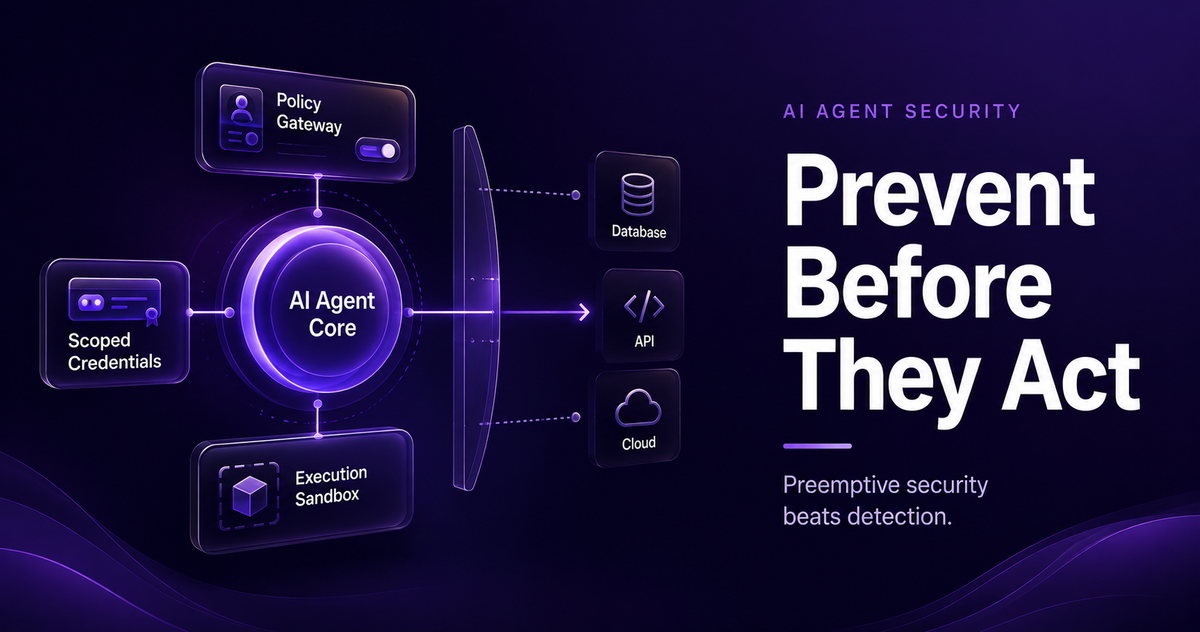
Preemptive cybersecurity for AI agents means constraining what an agent is permitted to do before it acts, rather than detecting misuse afterward. In 2026 the controls that hold are agent inventory, just-in-time task-scoped credentials, authorisation enforced in a policy gateway outside the model, ephemeral execution sandboxes, and egress allowlists. FinTech and HealthTech teams need these because machine identities now outnumber human ones roughly 109 to one. Detection alone arrives too late.
The security question inside an agentic system is not the one most teams are still budgeting for. It is not who is trying to get in. It is what the thing already inside is permitted to do, and who authorised it.
An AI agent is not a chatbot with better manners. It plans, holds memory, calls tools, and acts across systems with delegated authority and a working credential. Palo Alto Networks put the scale of that shift in its 2026 Identity Security Landscape report: organisations now manage an average of 109 machine identities for every human identity, and expect AI agent identities specifically to grow 85% over the next twelve months. Most teams surveyed could explain what their agents are for. Far fewer could say what those agents can reach, how that access is limited, or when it gets revoked.
That gap is where this year's incidents are landing.
Detection Assumes Time You No Longer Have
Detection and response was designed around dwell time. An attacker probes, gains a foothold, moves laterally over days or weeks, and a well-instrumented team finds them somewhere inside that window. Agentic tooling collapses the window.
Palo Alto Networks' Unit 42 built an agentic attack framework to test that assumption and found an agent could complete a full ransomware lifecycle in roughly 25 minutes. In May 2026, Unit 42 documented a live campaign in which a threat actor's agent identified a Langflow vulnerability, attempted exploitation, judged the target low value, then went hunting for a better one on its own by surveying deployment counts and scanning GitHub for recent proof-of-concept repositories. No operator input was recovered beyond the initial task.
The trend line is not speculative. , released on 3 August, found AI-enabled malicious activity surged 89% over the past year, with China-nexus adversaries exploiting critical vulnerabilities within 24 hours of a public proof of concept. for 2026 and projects that preemptive solutions will account for half of all IT security spending by 2030, up from under 5% in 2024. That forecast is not a fashion cycle. It is arithmetic about response windows.
About The Author

EPixelSoft Team
LinkedInThe EPixelSoft engineering team has spent 12 years building production software for organizations where the stakes are high — FinTech lenders, HealthTech platforms, international NGOs, and funded SaaS startups across the US, UK, Africa, and Asia. With 700+ systems shipped and a proprietary AI platform running in the field, the team writes from direct delivery experience: what breaks in production, what actually works, and what the vendor pitch never tells you.