Vibe Coding Production Risks: What Breaks When Nobody on the Team Understands the Code


The main vibe coding production risks are insecure defaults, missing access control, untested business rules, and code no one can debug. Veracode's 2025 study of more than 100 language models found that 45% of coding tasks produced code with OWASP Top 10 vulnerabilities. For SaaS founders and fintech teams shipping AI-written PHP, Python, or JavaScript, the safe practice is to have a named engineer read, test, and own every change before it reaches production.
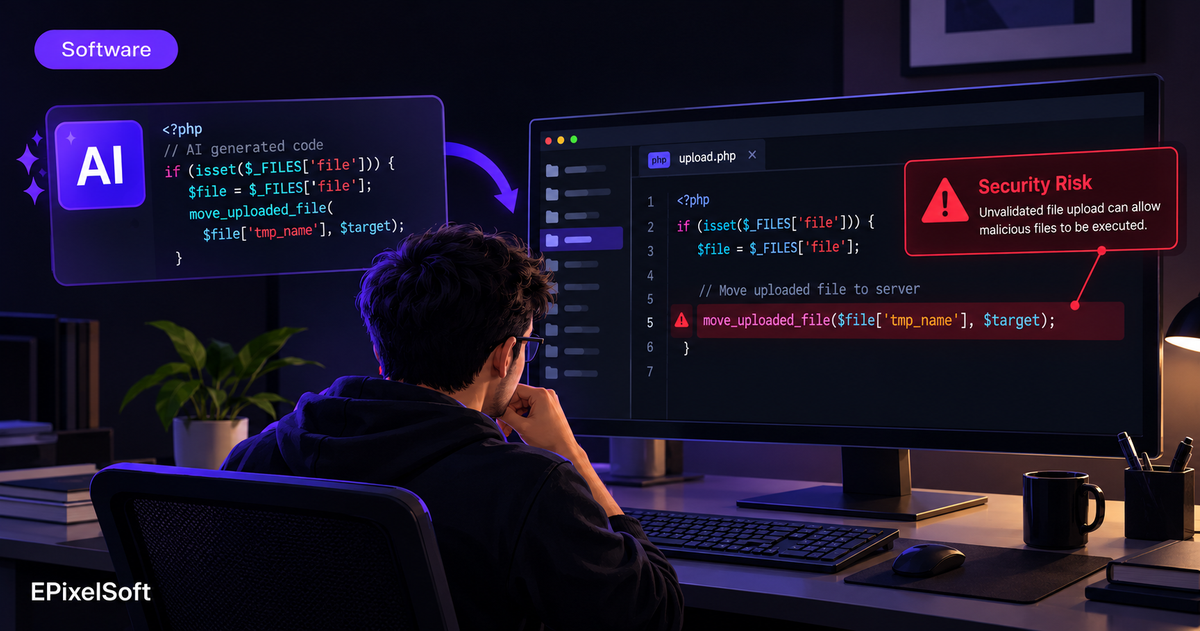
Picture a founder who knows no PHP. They type a prompt into an AI tool: write a function that lets a customer upload a document and attach it to their account. The model returns forty tidy lines. The founder pastes them in, uploads a test file, watches it appear, and pushes to production.
Nothing looks wrong, because nothing has gone wrong yet. The code runs. The demo works. What the founder cannot see is what happens when someone uploads a file named invoice.php, or edits an account ID in the request, or when the same code meets ten thousand rows instead of ten.
The scenario is hypothetical. The pattern is documented. Researchers have measured it at scale over the past year, and the cost lands on people who never wrote a prompt: the customers whose data sits in the database. This post covers what actually breaks, in what order, and what accountable AI-assisted development looks like in practice.
Working Code and Safe Code Are Different Things
AI models are good at producing code that does what the prompt describes. They are much weaker at handling what the prompt never mentioned. Veracode tested more than 100 language models on 80 coding tasks built around known weakness types. In 45% of cases the generated code introduced an OWASP Top 10 vulnerability, and when both a secure and an insecure method were available, the models chose the insecure one 45% of the time. The code was functional and syntactically correct. It was also exploitable.
PHP shows the same pattern. Researchers at the University of Oslo generated 2,500 small PHP websites with GPT-4 using neutral prompts, then tested them with Burp Suite and manual review. Of the 482 sites that accepted file uploads, 78% had no check on file extensions, which is the opening for the invoice.php problem above. Among sites that ran SQL queries, at least half skipped prepared statements, the standard defence against SQL injection. The model was GPT-4 and the sites were small single-file builds, so treat the exact percentages as indicative. The direction matches Veracode, whose CTO Jens Wessling said the failure rate was not improving.
About The Author

EPixelSoft Team
LinkedInThe EPixelSoft engineering team has spent 12 years building production software for organizations where the stakes are high — FinTech lenders, HealthTech platforms, international NGOs, and funded SaaS startups across the US, UK, Africa, and Asia. With 700+ systems shipped and a proprietary AI platform running in the field, the team writes from direct delivery experience: what breaks in production, what actually works, and what the vendor pitch never tells you.